
Talent Quarter Achieves ISO 9001 Certification with Certex
Chris O • May 13, 2026
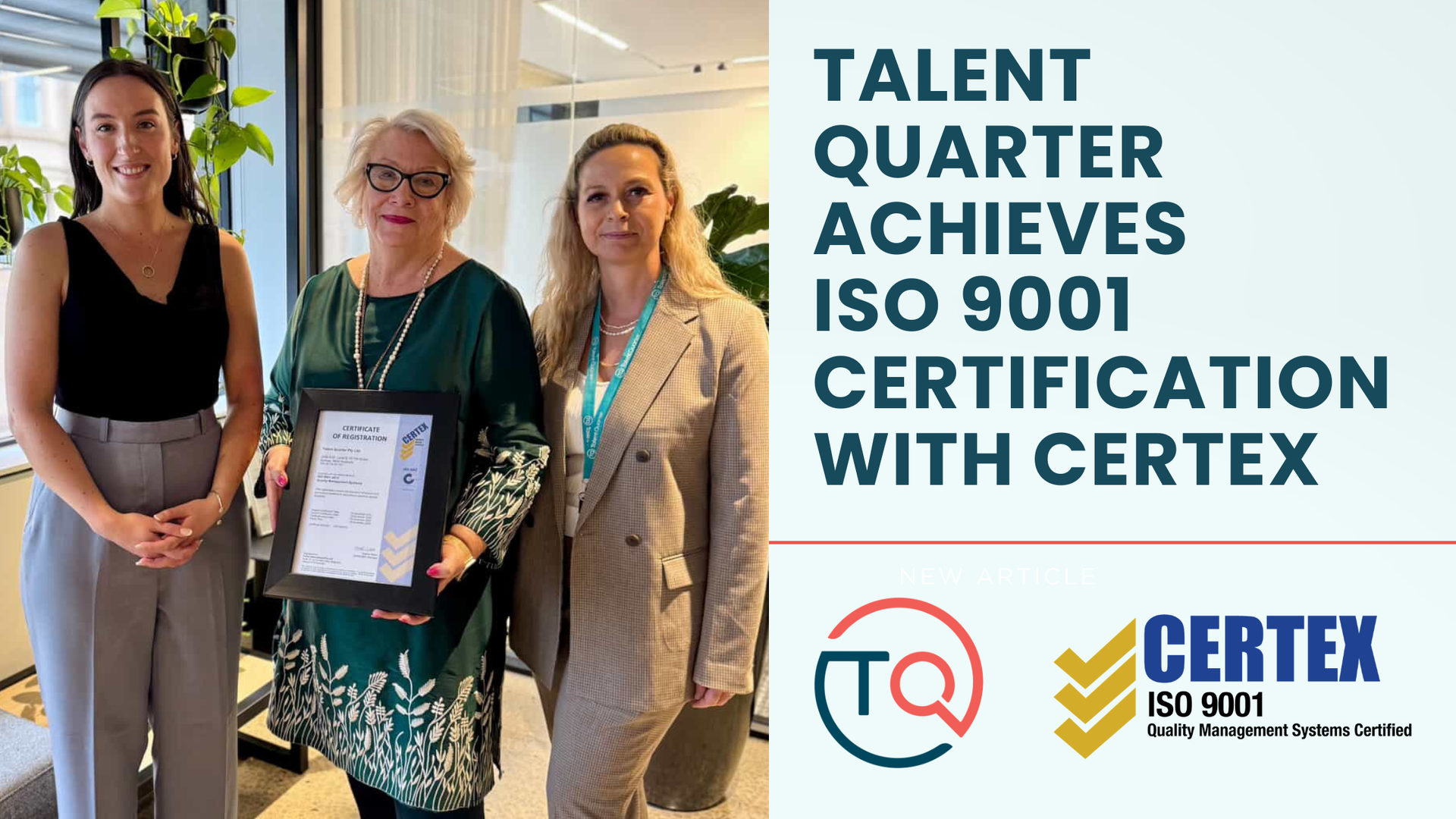
Here at Talent Quarter, providing quality support to both healthcare professionals and clients has always been a core part of how we work.
Achieving ISO 9001 Quality Management Systems (QMS) certification with Certex is an important milestone that reflects the care, consistency and accountability we aim to bring to everything we do.
As a healthcare recruitment and workforce solutions partner operating across Australia, Talent Quarter works closely with nurses, midwives, doctors, allied health professionals and social care workers across metro, regional and remote communities.
What is ISO 9001 — and Why Does It Matter?
ISO 9001 is an internationally recognised quality management standard designed to help organisations improve the way they operate, deliver services consistently and continually review how they can do things better. Rather than being a simple “tick-box” exercise, it requires businesses to build clear processes, strengthen accountability and create structured systems around risk management, documentation, communication and continuous improvement.
Pursuing ISO 9001 certification gave the team an opportunity to strengthen and formalise many of the quality processes already in place across the business. As our organisation continues to grow and support more government and healthcare partners, having a recognised framework helps ensure services remain consistent, compliant and people-focused.
The certification journey involved reviewing internal systems, refining documentation and improving visibility across processes and responsibilities. While it required time and collaboration across teams, it also created valuable opportunities to improve the way Talent Quarter works internally and supports its clients and candidates externally.
Shannon O’Fionnagain, Executive Head of Operational Strategy & Governance at Talent Quarter, shared:
“It strengthens customer confidence, supports improved customer satisfaction, and reinforces our culture of continuous improvement.”
Certex’s collaborative and industry-informed approach played a key role throughout the process, helping ensure the certification journey remained both practical and aligned with Talent Quarter’s operational environment.
For us, this certification is not just about achieving a standard - it’s about continuing to build trust, improve experiences and support healthcare communities with care and consistency.
Share this post

If you've spent a few years in Emergency, chances are you've thought about it. "Could I do remote nursing?"

When our Nurse Alex moved from Northern Ireland to Australia in November 2025 , she wanted to do two things: work as a nurse and make the most of the opportunity to explore Australia. Travel nursing has given her the chance to do both! Making the most of the time between contracts 🐋 After wrapping up a contract, Alex headed to the Gold Coast for some well-earned downtime - which happened to fall right in the middle of humpback whale migration season. “I went whale watching which was incredible. It was peak season for humpback whales migrating down the east coast. There were so many whales!” For Alex, taking a break between contracts isn’t just about travelling. It gives her a chance to properly switch off after working in demanding and sometimes unfamiliar environments. “Contracts can be both physically and mentally demanding at times, and working in unknown environments can be overwhelming. Having time off between contracts has helped me recharge to be ready for the next contract.” Work, travel and a bit more freedom One of the things Alex has enjoyed most is being able to choose contracts that suit her experience and the way she wants to spend her time in Australia. “It’s great being able to balance the work and the holiday aspects of my Working Holiday Visa. As much as I love work, I love being able to see and experience Australia in all of its beauty in my downtime.” It’s also given her the chance to broaden her nursing experience. Alex comes from an ICU background, but since starting travel nursing she’s also worked in ED and on a medical ward. And then there are the places. Instead of only visiting somewhere for a weekend, Alex gets to spend a few weeks living and working there - experiencing smaller towns and parts of Australia she might never otherwise have had the chance to call home. Next stop: Tasmania 📍 Alex has now started a new contract in Tasmania, where she’s looking forward to gaining more ED experience and, of course, exploring more of the state while she’s there. For any nurses thinking about doing something similar, Alex’s advice is pretty simple: “Do it! I was nervous to start travel nursing, but I’m so glad I did it. The team at Talent Quarter supported and guided me throughout the whole way. They are always just a phone call away.” For Alex, it’s that freedom that makes travel nursing so worthwhile. “You could work the full year straight if you want, or take months off at a time to travel. It’s up to you.” A new contract, a new part of Australia and the freedom to decide what comes next. That’s what travel nursing has looked like for Alex so far. Thinking about giving travel nursing a go? Whether you’re ready for your next contract or just curious about what opportunities are out there, we’d love to hear from you . Get in touch with our Talent Quarter team and have a chat about where travel nursing could take you next! Click here: https://www.talentquarter.com/contact-us or get in touch with our consultant, Lewis Dew!

Not every bad week means you need a new job. But not every comfortable job is one you should stay in. Sometimes the signs are obvious. You've stopped enjoying the work, there's nowhere left to grow, or an opportunity comes along that's simply too good to ignore. More often, it's less clear. The job is fine. You like the people. You know what you're doing. You're comfortable. But somewhere in the back of your mind is the question: Is it time for something else? Instead of simply asking "Do I want to leave?" , it can be more useful to ask: "Is staying still the right decision for my career?" Here are five questions to help you decide. Am I still learning? Career progression doesn't always mean a promotion or a bigger title. You might be developing new capabilities, dealing with more complex challenges, working with people you can learn from or gaining experience that will open doors later. Ask yourself: What can I do now that I couldn't do 12 months ago? What am I learning in this role today? What will I be better at 12 months from now if I stay? There's nothing wrong with being good at your job. But being comfortable and continuing to grow aren't always the same thing. Is there genuinely somewhere for me to go? It's easy to stay because of what might happen. "There could be an opportunity next year." "My manager has said I'm next in line." "They're talking about creating another position." Sometimes those opportunities materialise. Sometimes another year passes, and you're having exactly the same conversation. If your reason for staying relies heavily on a future opportunity, find out how real it is. What needs to happen? What's the likely timeframe? What do you still need to demonstrate? There is a difference between potential and wishful thinking . What is staying costing me? When we're considering a move, we naturally think about the risks of leaving. What if I don't like the new organisation? What if the role isn't what I expected? What if I leave a great team? They're sensible questions. But what about the risk of staying? If you remain where you are for another two years, what might you not experience? Perhaps it's leading a larger team, gaining new expertise, working in a different environment or taking on greater responsibility. Every career decision has an opportunity cost. Don't only ask: “What might I lose if I leave?” Ask: "What might I miss if I stay?" Am I moving towards something or simply away from something? A frustrating job can make almost any alternative look attractive. Before making a move, separate what you're trying to get away from, and what you're trying to move towards . You may want to escape poor leadership, excessive workload or limited progression. But what do you actually want instead? More responsibility? Better leadership? Greater flexibility? A different clinical environment? More autonomy? A new challenge? Knowing what you're moving towards makes it much easier to assess whether another opportunity is genuinely better or simply different. What would need to change for me to stay? Before deciding the answer is another job, ask: What would need to change for me to happily stay here for another two years? Perhaps you need more responsibility, greater flexibility, better development opportunities or a clearer progression path. Then ask: Have I actually asked for it? We can spend months becoming increasingly dissatisfied with something we've never had a direct conversation about. Not every problem can be solved. But before leaving a good organisation, it's worth finding out whether what you're looking for elsewhere could exist where you already are. You don't need to resign to explore the market Talking to a recruiter doesn't mean you've decided to leave. Looking at opportunities doesn't mean you're disloyal. And going to an interview doesn't mean you have to accept the job. Sometimes exploring the market is simply good career management. What opportunities are available? What are employers looking for? How is your experience valued? What could your next step realistically look like? You may discover an opportunity that excites you. Or you may discover that staying exactly where you are is the right decision. Either way, you've made that decision with better information. There is no rule that says you should change jobs every two, three or five years. Sometimes staying is the best career move you can make. Sometimes leaving is. The important thing is that neither happens simply by default. So perhaps the question isn't: "Should I stay or should I go?" It's: "Which decision puts me in a better place two or three years from now?"