
The Growing Demand for Medical Imaging Professionals Across Australia
Chris O • August 19, 2026
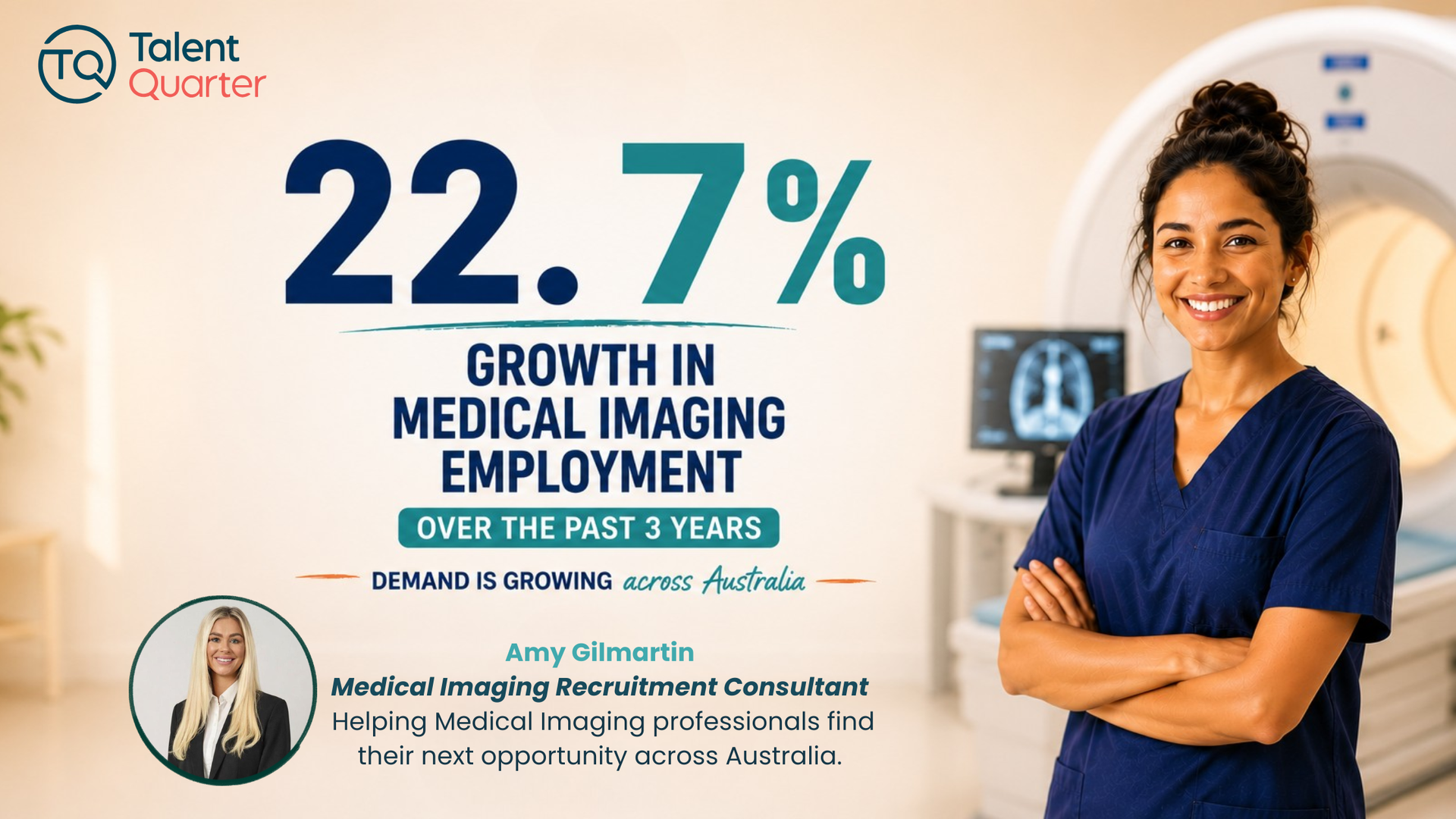
Demand for skilled Medical Imaging professionals is growing across Australia and the numbers tell the story.
In 2024–25, Australians received 32.2 million Medicare-subsidised diagnostic imaging services, up from 23.9 million a decade earlier. Around 10.8 million Australians (almost 40% of the population) accessed diagnostic imaging during the year.
For Radiographers, Sonographers and other Medical Imaging professionals, that demand is creating opportunities across metropolitan, regional and coastal Australia.
A growing profession...
Jobs and Skills Australia reports around 25,700 Medical Imaging professionals were employed in Australia in November 2025, with employment increasing by 22.7% over the previous three years. Employment is projected to grow by a further 18.1% over the five years to May 2030.
At Talent Quarter, we’re seeing opportunities across:
- General Radiography
- CT
- MRI
- Ultrasound / Sonography
- Nuclear Medicine
- Mammography
- Senior and leadership roles
“I really am seeing strong demand for experienced imaging professionals across Australia, particularly for candidates with CT, MRI and ultrasound experience. What’s exciting is the variety of opportunities available, whether you’re wanting career progression, an exciting new location or coastal lifestyles, there’s more to look forward to than just your next job.”
- Amy Gilmartin, Medical Imaging Recruitment Consultant, Talent Quarter
Imaging demand continues to rise
Diagnostic imaging is an essential part of modern healthcare, supporting everything from emergency medicine and injury assessment to cancer diagnosis, screening and ongoing treatment. And service volumes are increasing.
Between 2014–15 and 2024–25, Medicare-subsidised:
- CT services increased 87%, from 2.8 million to 5.2 million
- MRI services increased 60%, from 1 million to 1.6 million
- Ultrasound reached 12.9 million services in 2024–25
- Diagnostic radiography reached 11.5 million services in 2024–25.
Australia’s ageing population is also likely to keep healthcare demand high. The proportion of Australians aged 65+ is projected to rise from 17% in 2022 to 25–27% by 2071.
More opportunities, more choice
For Medical Imaging professionals, demand isn't limited to the major cities.
There are so many regional and coastal opportunities which offer a different combination of career development, lifestyle and community, while metropolitan and private imaging roles can provide access to specialised services, modern technology and leadership pathways.
For international professionals considering Australia, there are opportunities for you too! Depending on your profession and circumstances, Radiographers may need AHPRA registration, while Sonographers may need ASAR accreditation or eligibility, alongside any relevant visa and employer requirements.
Understanding your pathway early can make the move much easier.
Ready for your next move?
Whether you're looking for a permanent position, locum opportunity, regional experience or a move to Australia, Talent Quarter can help you understand what's available.
We work with Medical Imaging professionals to find opportunities that fit more than their CV -considering career goals, location, lifestyle and the type of team they want to join.
If you’re a Radiographer, Sonographer or Medical Imaging professional wondering what your next move could look like, have a chat with Amy Gilmartin.
Share this post

If you've spent a few years in Emergency, chances are you've thought about it. "Could I do remote nursing?"

When our Nurse Alex moved from Northern Ireland to Australia in November 2025 , she wanted to do two things: work as a nurse and make the most of the opportunity to explore Australia. Travel nursing has given her the chance to do both! Making the most of the time between contracts 🐋 After wrapping up a contract, Alex headed to the Gold Coast for some well-earned downtime - which happened to fall right in the middle of humpback whale migration season. “I went whale watching which was incredible. It was peak season for humpback whales migrating down the east coast. There were so many whales!” For Alex, taking a break between contracts isn’t just about travelling. It gives her a chance to properly switch off after working in demanding and sometimes unfamiliar environments. “Contracts can be both physically and mentally demanding at times, and working in unknown environments can be overwhelming. Having time off between contracts has helped me recharge to be ready for the next contract.” Work, travel and a bit more freedom One of the things Alex has enjoyed most is being able to choose contracts that suit her experience and the way she wants to spend her time in Australia. “It’s great being able to balance the work and the holiday aspects of my Working Holiday Visa. As much as I love work, I love being able to see and experience Australia in all of its beauty in my downtime.” It’s also given her the chance to broaden her nursing experience. Alex comes from an ICU background, but since starting travel nursing she’s also worked in ED and on a medical ward. And then there are the places. Instead of only visiting somewhere for a weekend, Alex gets to spend a few weeks living and working there - experiencing smaller towns and parts of Australia she might never otherwise have had the chance to call home. Next stop: Tasmania 📍 Alex has now started a new contract in Tasmania, where she’s looking forward to gaining more ED experience and, of course, exploring more of the state while she’s there. For any nurses thinking about doing something similar, Alex’s advice is pretty simple: “Do it! I was nervous to start travel nursing, but I’m so glad I did it. The team at Talent Quarter supported and guided me throughout the whole way. They are always just a phone call away.” For Alex, it’s that freedom that makes travel nursing so worthwhile. “You could work the full year straight if you want, or take months off at a time to travel. It’s up to you.” A new contract, a new part of Australia and the freedom to decide what comes next. That’s what travel nursing has looked like for Alex so far. Thinking about giving travel nursing a go? Whether you’re ready for your next contract or just curious about what opportunities are out there, we’d love to hear from you . Get in touch with our Talent Quarter team and have a chat about where travel nursing could take you next! Click here: https://www.talentquarter.com/contact-us or get in touch with our consultant, Lewis Dew!

Not every bad week means you need a new job. But not every comfortable job is one you should stay in. Sometimes the signs are obvious. You've stopped enjoying the work, there's nowhere left to grow, or an opportunity comes along that's simply too good to ignore. More often, it's less clear. The job is fine. You like the people. You know what you're doing. You're comfortable. But somewhere in the back of your mind is the question: Is it time for something else? Instead of simply asking "Do I want to leave?" , it can be more useful to ask: "Is staying still the right decision for my career?" Here are five questions to help you decide. Am I still learning? Career progression doesn't always mean a promotion or a bigger title. You might be developing new capabilities, dealing with more complex challenges, working with people you can learn from or gaining experience that will open doors later. Ask yourself: What can I do now that I couldn't do 12 months ago? What am I learning in this role today? What will I be better at 12 months from now if I stay? There's nothing wrong with being good at your job. But being comfortable and continuing to grow aren't always the same thing. Is there genuinely somewhere for me to go? It's easy to stay because of what might happen. "There could be an opportunity next year." "My manager has said I'm next in line." "They're talking about creating another position." Sometimes those opportunities materialise. Sometimes another year passes, and you're having exactly the same conversation. If your reason for staying relies heavily on a future opportunity, find out how real it is. What needs to happen? What's the likely timeframe? What do you still need to demonstrate? There is a difference between potential and wishful thinking . What is staying costing me? When we're considering a move, we naturally think about the risks of leaving. What if I don't like the new organisation? What if the role isn't what I expected? What if I leave a great team? They're sensible questions. But what about the risk of staying? If you remain where you are for another two years, what might you not experience? Perhaps it's leading a larger team, gaining new expertise, working in a different environment or taking on greater responsibility. Every career decision has an opportunity cost. Don't only ask: “What might I lose if I leave?” Ask: "What might I miss if I stay?" Am I moving towards something or simply away from something? A frustrating job can make almost any alternative look attractive. Before making a move, separate what you're trying to get away from, and what you're trying to move towards . You may want to escape poor leadership, excessive workload or limited progression. But what do you actually want instead? More responsibility? Better leadership? Greater flexibility? A different clinical environment? More autonomy? A new challenge? Knowing what you're moving towards makes it much easier to assess whether another opportunity is genuinely better or simply different. What would need to change for me to stay? Before deciding the answer is another job, ask: What would need to change for me to happily stay here for another two years? Perhaps you need more responsibility, greater flexibility, better development opportunities or a clearer progression path. Then ask: Have I actually asked for it? We can spend months becoming increasingly dissatisfied with something we've never had a direct conversation about. Not every problem can be solved. But before leaving a good organisation, it's worth finding out whether what you're looking for elsewhere could exist where you already are. You don't need to resign to explore the market Talking to a recruiter doesn't mean you've decided to leave. Looking at opportunities doesn't mean you're disloyal. And going to an interview doesn't mean you have to accept the job. Sometimes exploring the market is simply good career management. What opportunities are available? What are employers looking for? How is your experience valued? What could your next step realistically look like? You may discover an opportunity that excites you. Or you may discover that staying exactly where you are is the right decision. Either way, you've made that decision with better information. There is no rule that says you should change jobs every two, three or five years. Sometimes staying is the best career move you can make. Sometimes leaving is. The important thing is that neither happens simply by default. So perhaps the question isn't: "Should I stay or should I go?" It's: "Which decision puts me in a better place two or three years from now?"