





The Nursing & Midwifery Interview Guide: How to Prepare, What to Expect and Tips to Help You Feel Confident
Chris O • November 24, 2026
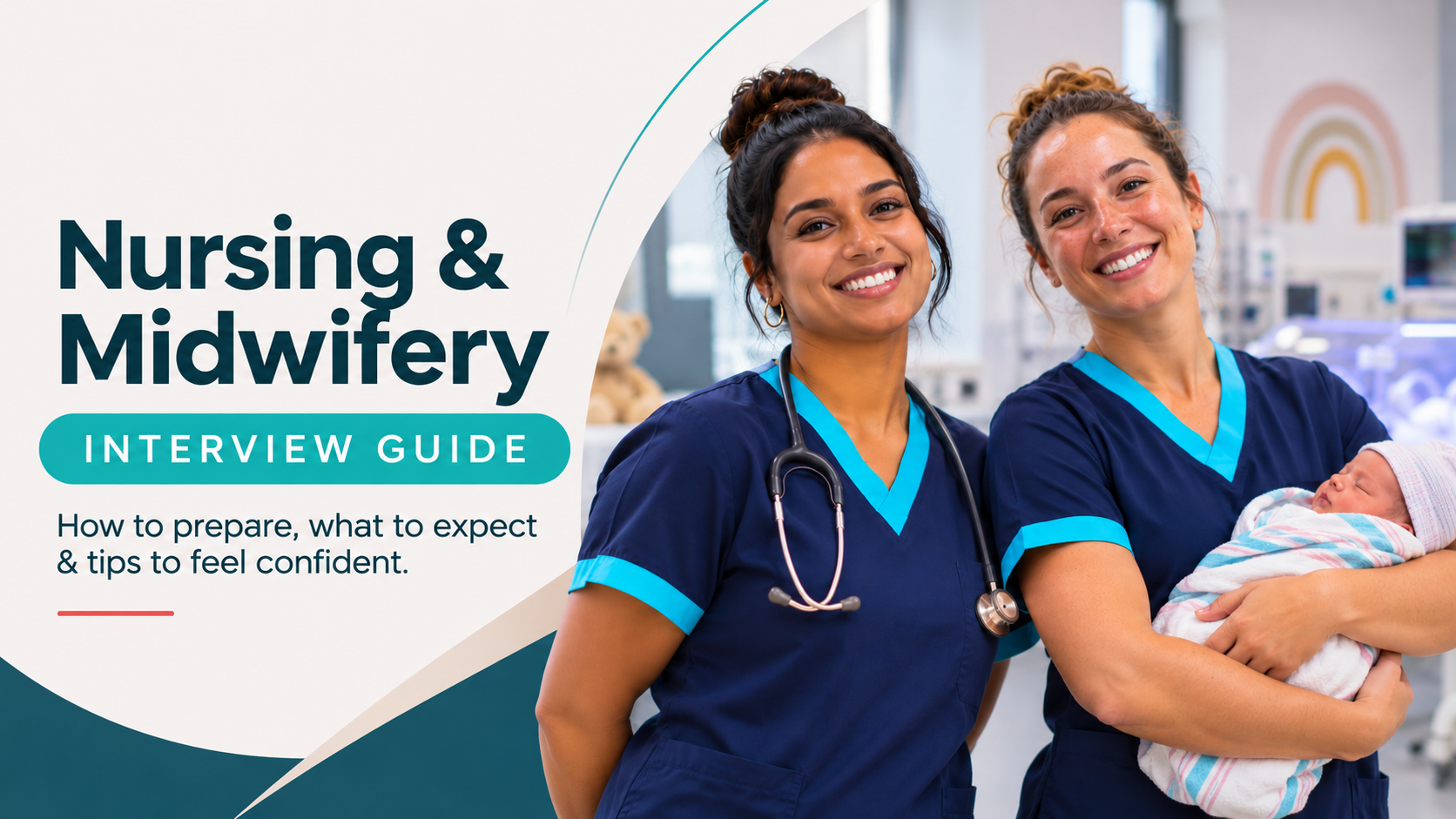
Got a nursing or midwifery interview coming up? We've got you covered.
Let's be real. Even if you've spent years working in busy wards, navigating challenging situations and caring for patients, sitting down for an interview can still feel a little nerve-racking.
Suddenly, you're expected to talk about yourself, remember examples from your career and explain why you're the right person for the job. All while trying not to forget everything you've ever learned!
The good news? An interview isn't about having the perfect answer to every question. It's about showing who you are, what you bring to the team and how you approach patient care.
Whether you're a newly qualified nurse, an experienced midwife or looking to explore a new specialty, a little preparation can go a long way.
So, let's get you interview-ready.
1. Do your homework (but don't overthink it!)
Before your interview, spend a little time getting familiar with the organisation and the role.
You don't need to memorise their entire website, but understanding their values, patient population and services will help you feel more prepared.
A few things worth looking into:
- The organisation: Is it a public hospital, private facility, community health service or maternity unit?
- The role: What responsibilities, skills and experience are they looking for?
- The team: Will you be working in a specialised unit, multidisciplinary team or regional healthcare setting?
- The location: If you're considering a regional or rural opportunity, what do you know about the community and local healthcare services?
And remember, interviews go both ways! You're also figuring out whether the role and workplace are right for you.
A little advice from our Nursing & Midwifery team
"What's the one thing you always tell your nursing or midwifery candidates to do before an interview? Is there anything candidates tend to overlook?"
My number one tip is to prepare your examples in advance. Think through the who, what, where and why of a few real situations so you can answer situational questions clearly and concisely.
Next, research the hospital, healthcare provider and ward. Weave their values and model of care into your answers, because it shows you understand the service and align with how they work.
Finally, don’t be afraid to come with questions of your own! Asking thoughtful questions shows genuine interest in the role.
— Kathryn Galloway, Recruitment Consultant - Permanent Nursing, Talent Quarter
2. Get comfortable talking about your experience
One of the most common interview challenges isn't a lack of experience. It's knowing how to explain that experience clearly. You might be brilliant at what you do, but when someone asks you to describe a time you managed a difficult situation, suddenly your mind goes blank.
Sound familiar?
That's where having a few examples prepared can really help.
Think about situations where you've:
- Managed competing priorities during a busy shift.
- Supported a patient or family through a challenging experience.
- Worked closely with a multidisciplinary team.
- Identified a patient safety concern and taken appropriate action.
- Adapted to an unfamiliar environment or changing circumstances.
- Demonstrated compassion, cultural awareness or patient advocacy.
You don't need an extraordinary story. Sometimes the everyday moments say the most about the kind of healthcare professional you are.
3. Meet your new best friend: the STAR method
If you've ever been asked, "Can you tell us about a time when...?" you're probably familiar with behavioural interview questions.
These questions are designed to understand how you've handled real situations, rather than just what you know in theory.
A simple way to structure your answers is the STAR method.
S — Situation: Briefly explain what was happening.
T — Task: What was your responsibility?
A — Action: What did you actually do?
R — Result: What happened, and what did you learn?
Here's an example
Interview question: "Tell us about a time you had to manage competing priorities."
Situation: During a particularly busy shift, several patients required attention at the same time.
Task: I needed to prioritise care safely while keeping the team informed.
Action: I assessed the urgency of each patient's needs, escalated concerns where appropriate, communicated with my colleagues and delegated tasks within the team's scope of practice.
Result: We were able to manage the workload safely, and the experience reinforced the importance of communication, teamwork and regularly reassessing priorities.
See? Nothing overly complicated! The key is to be specific about your contribution rather than simply saying what the team did.
And if the outcome wasn't perfect? That's okay too. Being able to reflect on what you learned shows maturity and a commitment to improving your practice.
4. Questions you might be asked in a nursing or midwifery interview
Every organisation has its own interview process, but there are a few common themes worth preparing for.
General nursing and midwifery questions
- Can you tell us a little about yourself and your clinical background?
- What interested you in this particular role?
- How do you prioritise patient care during a busy shift?
- Tell us about a time you dealt with a challenging situation.
- How do you approach conflict or disagreements within a team?
- What does patient-centred care mean to you?
- How do you maintain your professional development?
- How do you ensure culturally safe and respectful care?
For nurses
Depending on your specialty, you might also be asked about recognising and escalating patient deterioration, medication safety, clinical handovers, infection prevention or working within your scope of practice.
For midwives
You may be asked about supporting informed decision-making, recognising maternal or neonatal complications, responding to obstetric emergencies, collaborating with the wider maternity team or providing woman-centred and culturally safe care.
For travel, rural and regional roles
If you're interviewing for a contract away from home, expect some questions about adaptability.
For example:
- How do you settle into a new clinical environment?
- What experience do you have working with unfamiliar teams?
- How do you manage situations where resources or support may differ from what you're used to?
- What interests you about working in a rural or regional community?
You won't necessarily be asked all these questions, but thinking through a few examples beforehand can help you feel much more comfortable on the day. And when answering clinical scenarios, remember to work within your professional scope and refer to appropriate escalation processes and local policies.
5. Don't forget the soft skills (they matter more than you think!)
Clinical knowledge and experience are essential, of course. But at the end of the day, healthcare is about people. The way you communicate, collaborate, listen and respond under pressure can tell an interviewer just as much about you as your qualifications.
Think about how you demonstrate:
Communication: Can you explain complex information clearly and compassionately?
Teamwork: How do you support colleagues and contribute to a positive workplace?
Adaptability: How do you respond when plans change or unexpected situations arise?
Empathy: How do you make patients and families feel heard, respected and supported?
Cultural safety: How do you reflect on your own practice and provide respectful, inclusive care?
You don't need to describe yourself as a "great communicator" or a "team player" and leave it at that. Show them through your examples.
What do hiring managers really look for?
Hiring managers are not simply looking for someone who can do the job clinically. They're looking for someone who will be a valuable addition to their team, contribute positively to the workplace and provide safe, compassionate patient care.
Our Advice to Nurses and Midwives
When preparing for your next interview, don't just focus on listing your clinical experience, qualifications or technical skills. Share your experiences. Tell your story.
Talk about a time you supported a colleague, managed a challenging situation, adapted to a new clinical environment or advocated for a patient. These real-life examples give hiring managers a better understanding of who you are, not just as a clinician, but as a person and a potential team member.
At the end of the day, clinical skills may get you shortlisted, but your attitude, professionalism, adaptability and ability to connect with people can be what makes you stand out.
And as someone who has worked on both sides of healthcare, as a nurse and now in recruitment, I strongly believe that the best candidates are not necessarily those with the longest resumes, but those who bring the right combination of competence, compassion and commitment to their profession.
- Jeane Seducon Daw WA Health Account Manager | Talent Quarter Healthcare Recruitment | Nursing & Midwifery
6. Have a few questions of your own
Here's something people sometimes forget: you're allowed to ask questions too!
In fact, asking thoughtful questions shows you're genuinely interested in the opportunity.
A few good ones include:
- What does a typical shift look like for someone in this role?
- How would you describe the team culture?
- What orientation and support are provided to new team members?
- Are there opportunities for professional development or further training?
- What are the biggest priorities for the team at the moment?
- How does the organisation support staff wellbeing?
If you're considering a travel nursing or midwifery contract, you might also want to ask about accommodation, travel arrangements, roster expectations and what support is available when you arrive. These are all reasonable things to clarify before accepting an opportunity.
7. A few little things that make a big difference
Sometimes it's the simple things that help you feel more confident.
The day before:
- Check your interview time, location or video link.
- Revisit the position description.
- Prepare three or four examples using the STAR method.
- Have your qualifications, registration details and relevant documents handy if requested.
- Choose something comfortable and professional to wear.
- Try to get a decent night's sleep!
On the day:
- Give yourself enough time so you're not rushing.
- Listen carefully to each question.
- Take a moment to think before answering.
- Ask for clarification if you need it.
- Be yourself.
And if you're nervous? That's completely normal! You can even acknowledge it. Interviewers understand that people get nervous, and taking a moment to gather your thoughts is much better than rushing into an answer.
8. What if the interview doesn't go to plan?
Maybe you forgot to mention something important. Maybe you stumbled over a question. Or maybe… you walked out thinking of all the things you should have said. Well, trust us, we've all been there. One interview doesn't define your skills, your experience or your potential. If things don't go your way, try to see it as an opportunity to learn. Ask for feedback where possible, reflect on what you could improve and remember that the right opportunity might still be around the corner.
One last piece of advice from us
"What would you say to a nurse or midwife who's feeling nervous about an interview, particularly if they haven't interviewed in years or are considering a new specialty?"
Nerves are completely normal; they're a sign you care about the interview and the outcome, and do not mean that you're unprepared.
When preparing for your interview, I'd start by listing what you excel at day to day and what you'd bring to the next role: not just the clinical skills you hone every shift, but the non-clinical ones - compassion, teamwork, mentoring, life experience. Those are unique to you, so own them.
If it's been years since you interviewed, the fix is practice: rehearse with colleagues, family or your recruiter. Your recruiter can be a great rehearsal partner for you, they will happily drill the difficult questions with you and coach you on the best way to approach difficult or unknown questions. If you're moving to a new specialty, be honest about the gaps in your skills but lead with what transfers, your assessment, escalation, documentation, communication and prioritisation skills. Then show how you'd close the rest through orientation, shadowing or coaching. Interviewers aren't expecting someone who knows it all; they want someone open to learning, who is curious and keen to grow.
Know the selection criteria and have a concrete example ready for each, being sure to address the STAR format. I always suggest having good questions for the end such as asking about the team dynamics, day-to-day expectations and what they want from the person stepping into the role. Pay and conditions are usually better raised once there's an offer.
Prepare what you can control and embrace the nerves, because they show you care.
— Lorraine Morrison, MA (Hons), Lead Nursing Consultant, Talent Quarter
9. Remember, you don't have to navigate it all alone
Whether you're preparing for your first interview in years, looking to move into a different specialty or exploring nursing and midwifery opportunities across Australia, having someone in your corner can make the process feel a whole lot easier. At TQ, our Nursing & Midwifery consultants work closely with healthcare professionals to understand their experience, career goals and what matters most to them.
We're here to help you explore opportunities, understand what employers are looking for and feel prepared for the next step. Because finding the right role these days isn't just about what's on your CV, it's also about finding somewhere you can grow, feel supported and continue doing the work you love.
Ready for your next opportunity?
Explore our latest nursing and midwifery roles or get in touch with our Talent Quarter team. We'd love to hear from you! https://www.talentquarter.com/for-job-seekers
Share this post

A World Mental Health Day message from Jan Bannerman , Joint Managing Director, Talent Quarter

If you've spent a few years in Emergency, chances are you've thought about it. "Could I do remote nursing?"

When our Nurse Alex moved from Northern Ireland to Australia in November 2025 , she wanted to do two things: work as a nurse and make the most of the opportunity to explore Australia. Travel nursing has given her the chance to do both! Making the most of the time between contracts 🐋 After wrapping up a contract, Alex headed to the Gold Coast for some well-earned downtime - which happened to fall right in the middle of humpback whale migration season. “I went whale watching which was incredible. It was peak season for humpback whales migrating down the east coast. There were so many whales!” For Alex, taking a break between contracts isn’t just about travelling. It gives her a chance to properly switch off after working in demanding and sometimes unfamiliar environments. “Contracts can be both physically and mentally demanding at times, and working in unknown environments can be overwhelming. Having time off between contracts has helped me recharge to be ready for the next contract.” Work, travel and a bit more freedom One of the things Alex has enjoyed most is being able to choose contracts that suit her experience and the way she wants to spend her time in Australia. “It’s great being able to balance the work and the holiday aspects of my Working Holiday Visa. As much as I love work, I love being able to see and experience Australia in all of its beauty in my downtime.” It’s also given her the chance to broaden her nursing experience. Alex comes from an ICU background, but since starting travel nursing she’s also worked in ED and on a medical ward. And then there are the places. Instead of only visiting somewhere for a weekend, Alex gets to spend a few weeks living and working there - experiencing smaller towns and parts of Australia she might never otherwise have had the chance to call home. Next stop: Tasmania 📍 Alex has now started a new contract in Tasmania, where she’s looking forward to gaining more ED experience and, of course, exploring more of the state while she’s there. For any nurses thinking about doing something similar, Alex’s advice is pretty simple: “Do it! I was nervous to start travel nursing, but I’m so glad I did it. The team at Talent Quarter supported and guided me throughout the whole way. They are always just a phone call away.” For Alex, it’s that freedom that makes travel nursing so worthwhile. “You could work the full year straight if you want, or take months off at a time to travel. It’s up to you.” A new contract, a new part of Australia and the freedom to decide what comes next. That’s what travel nursing has looked like for Alex so far. Thinking about giving travel nursing a go? Whether you’re ready for your next contract or just curious about what opportunities are out there, we’d love to hear from you . Get in touch with our Talent Quarter team and have a chat about where travel nursing could take you next! Click here: https://www.talentquarter.com/contact-us or get in touch with our consultant, Lewis Dew!