
Meet Catherine Harris: The Leadership Mind Behind Project Roar
Chris Oliveira • March 5, 2026
Meet Catherine Harris: The Leadership Mind Behind Project Roar
At Talent Quarter, we really do believe strong workforce outcomes are driven by strong leadership. As part of our commitment to delivering meaningful value beyond recruitment, we’re proud to partner with Catherine Harris, Founder of Project Roar, to deliver a quarterly Leadership Masterclass Series focused on strengthening leadership capability across the sectors we support. Exciting!
This initiative reinforces an important objective for us, which is to deepen our client relationships through high-impact learning opportunities, helping organisations build stronger leadership capability across the sectors we support.
With over 20 years’ experience in career and leadership development, Catherine brings practical, outcome-focused insights that help organisations build high-performing, engaged teams. Ahead of the upcoming series, we sat down with Catherine to learn more about her background, her approach to leadership, and what participants can expect.
Q&A with Catherine Harris
For those who may not know you, can you tell us a little about your background and what led you to found Project Roar?
I’ve spent my entire career at the intersection of talent and leadership. I built my early career in recruitment before moving into senior internal talent roles, including heading up the Talent Acquisition function at Singtel Optus.
I led a leadership team responsible for all national hiring, from call centre through to C-suite, and what that experience really gave me was a front-row seat to what great leadership looks like and, just as importantly, what happens when it’s missing. You see the impact every day - in who stays, who leaves, who thrives, and who disengages. It almost always comes back to the leader.
From there I moved into a Business Manager role supporting one of the senior executives at Optus, which sharpened my commercial thinking and gave me a deep understanding of how leadership plays out at the executive level - the pressures, the decision-making, and the ripple effect a leader has across an entire organisation.
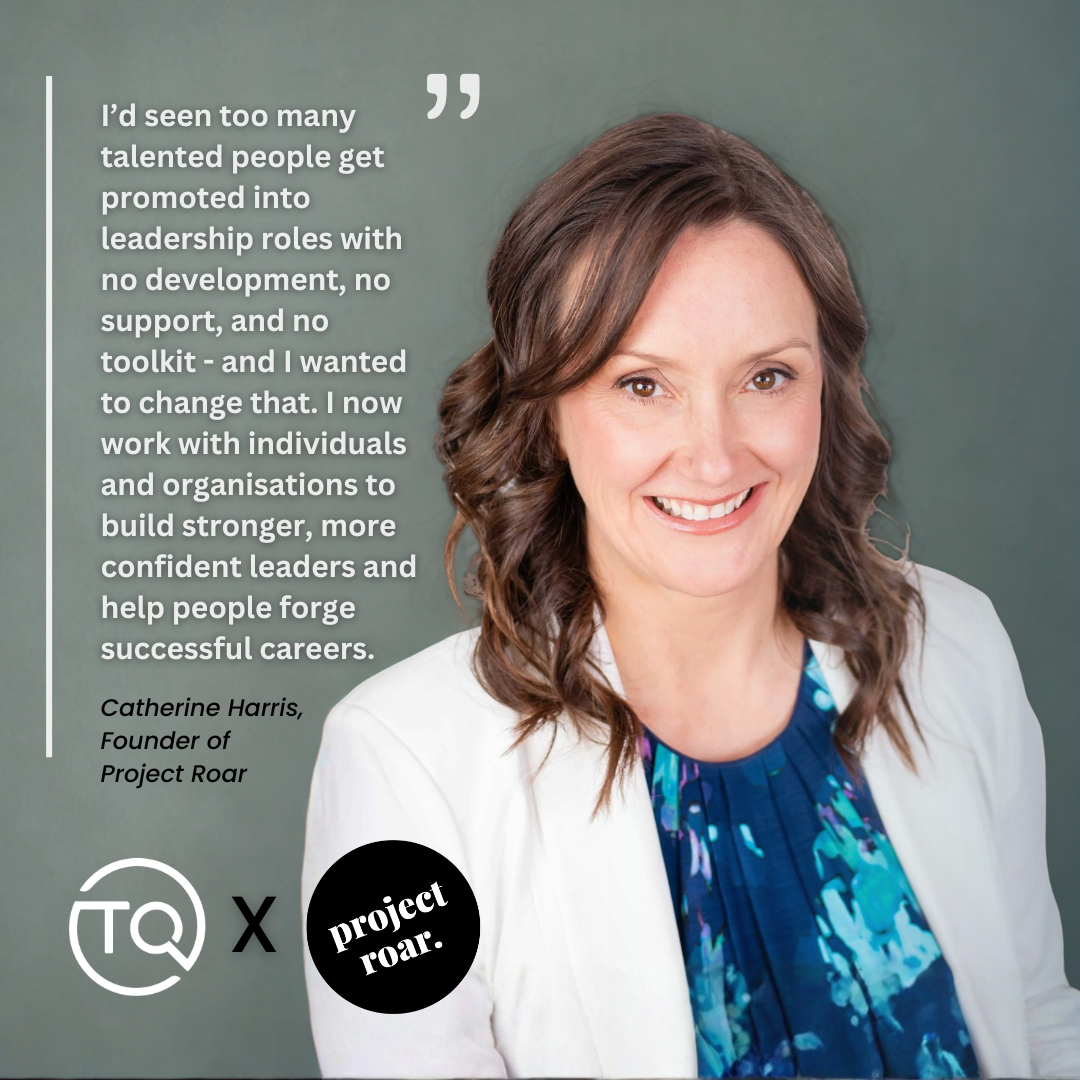
When I made the decision to leave corporate and eventually start Project Roar, I knew I wanted to focus on leadership and career coaching. I’d seen too many talented people get promoted into leadership roles with no development, no support, and no toolkit - and I wanted to change that. I now work with individuals and organisations to build stronger, more confident leaders and help people forge successful careers.
What can participants expect to walk away with from this Masterclass Series with Talent Quarter?
Honestly, the thing I’m most excited about is that we’re giving people development they wouldn’t normally prioritise.
We all know how it goes - leadership development is important, but it keeps getting bumped for the “real work.” This series removes that barrier. It’s bite-sized, practical, and designed to fit into a busy schedule through a lunch-and-learn format.
Across the four sessions, participants will build real, usable skills: how to delegate with clarity and confidence, how to have courageous conversations around underperformance, how to lead with positivity and a growth mindset, and how to communicate strategically to keep teams aligned and engaged.
These are the everyday leadership moments that make-or-break team performance, and participants will leave each session with something they can apply straightaway.
What’s one practical insight or shift you’re excited to share with participants?
The shift I see time and again in my coaching work is when leaders realise that the things holding them back aren’t big, complex strategic problems.
They’re the everyday leadership moments they’re not getting right.
They’re hanging onto tasks instead of delegating with clarity. They’re avoiding the tough conversation because they’re hoping the problem will sort itself out. They’re communicating reactively instead of strategically. Or they’re so focused on putting out fires that they’ve lost sight of the kind of leader they actually want to be.
What I love about this series is that each session tackles one of those moments head-on.
What’s one common mistake organisations make when developing leaders?
Simply not doing it.
That’s the honest answer.
Organisations will invest heavily in hiring the right people. They’ll invest in systems and technology. But when it comes to actually developing the leaders who are responsible for driving performance and culture every single day, it falls off the priority list.
People get promoted into leadership roles because they were brilliant at their previous job, and then they’re just expected to figure it out.
There’s no structured development, no coaching, no investment in the skills that leadership actually requires - things like delegation, communication, giving feedback, and navigating change.
And then we wonder why engagement drops or performance stalls. If you want strong leaders, you have to build them. It doesn’t happen by accident.
What’s Coming Next?
As part of this partnership, Talent Quarter and Project Roar will be launching a quarterly four-part Leadership Masterclass Series designed to equip leaders with practical tools they can apply immediately in their roles.
The first webinar, The Art of Delegation, will focus on helping leaders delegate with clarity and confidence by setting clear outcomes, defining ownership, and empowering their teams to take responsibility.
In the lead-up to the webinar and masterclass series, we’ll also be sharing a series of leadership insights and perspectives from Catherine, giving our community a preview of the thinking and practical strategies that will be explored further during the sessions.
Strengthening Leadership Across Health and Care
Through this Masterclass Series, Talent Quarter aims to equip leaders with practical tools that can be applied immediately, strengthening performance, communication and team effectiveness across health and care organisations.
We’re excited to partner with Catherine Harris and look forward to supporting our clients and partners through this initiative - continuing to invest in leadership capability across the sectors we serve. Stay tuned for the next instalment in this series!
Share this post

A World Mental Health Day message from Jan Bannerman , Joint Managing Director, Talent Quarter

If you've spent a few years in Emergency, chances are you've thought about it. "Could I do remote nursing?"

When our Nurse Alex moved from Northern Ireland to Australia in November 2025 , she wanted to do two things: work as a nurse and make the most of the opportunity to explore Australia. Travel nursing has given her the chance to do both! Making the most of the time between contracts 🐋 After wrapping up a contract, Alex headed to the Gold Coast for some well-earned downtime - which happened to fall right in the middle of humpback whale migration season. “I went whale watching which was incredible. It was peak season for humpback whales migrating down the east coast. There were so many whales!” For Alex, taking a break between contracts isn’t just about travelling. It gives her a chance to properly switch off after working in demanding and sometimes unfamiliar environments. “Contracts can be both physically and mentally demanding at times, and working in unknown environments can be overwhelming. Having time off between contracts has helped me recharge to be ready for the next contract.” Work, travel and a bit more freedom One of the things Alex has enjoyed most is being able to choose contracts that suit her experience and the way she wants to spend her time in Australia. “It’s great being able to balance the work and the holiday aspects of my Working Holiday Visa. As much as I love work, I love being able to see and experience Australia in all of its beauty in my downtime.” It’s also given her the chance to broaden her nursing experience. Alex comes from an ICU background, but since starting travel nursing she’s also worked in ED and on a medical ward. And then there are the places. Instead of only visiting somewhere for a weekend, Alex gets to spend a few weeks living and working there - experiencing smaller towns and parts of Australia she might never otherwise have had the chance to call home. Next stop: Tasmania 📍 Alex has now started a new contract in Tasmania, where she’s looking forward to gaining more ED experience and, of course, exploring more of the state while she’s there. For any nurses thinking about doing something similar, Alex’s advice is pretty simple: “Do it! I was nervous to start travel nursing, but I’m so glad I did it. The team at Talent Quarter supported and guided me throughout the whole way. They are always just a phone call away.” For Alex, it’s that freedom that makes travel nursing so worthwhile. “You could work the full year straight if you want, or take months off at a time to travel. It’s up to you.” A new contract, a new part of Australia and the freedom to decide what comes next. That’s what travel nursing has looked like for Alex so far. Thinking about giving travel nursing a go? Whether you’re ready for your next contract or just curious about what opportunities are out there, we’d love to hear from you . Get in touch with our Talent Quarter team and have a chat about where travel nursing could take you next! Click here: https://www.talentquarter.com/contact-us or get in touch with our consultant, Lewis Dew!